

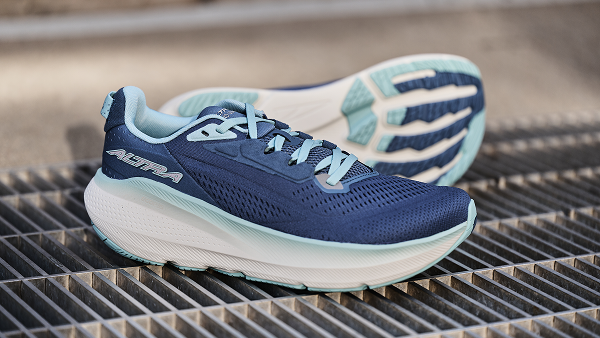

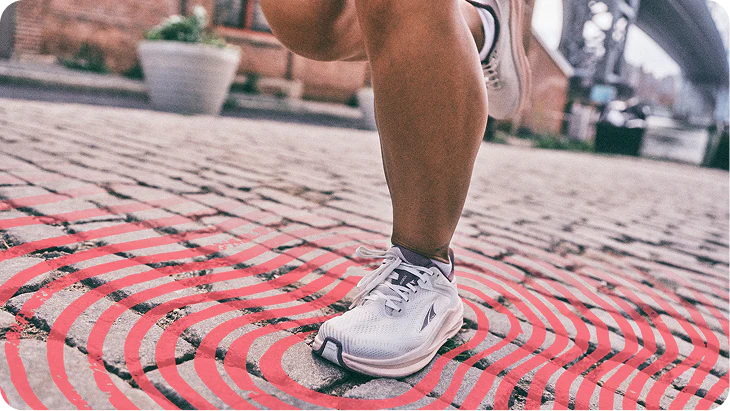
Have you spent time looking at different kinds of runnings shoes? If so, you’ll probably have come across terms such as heel-to-toe drop, low drop and zero drop. But what are zero drop shoes exactly? And, more importantly, how does their design affect the way you walk or run?
In general, heel-to-toe drop describes the difference in height between the heel and forefoot of a shoe. Zero drop footwear removes that height difference entirely, placing the heel and forefoot at the same level.
For some runners and walkers, moving towards a lower-drop platform can encourage the feet, ankles and lower legs to play a more active role in movement, which can offer considerable benefits to the way you exercise. However, changing your footwear also changes where forces are absorbed by the body, so making the change gradually is important.

What heel-to-toe drop means for your stride
Let’s go back to the question: what does heel to toe drop mean? Heel-to-toe drop, sometimes called a shoe's offset, is the difference in height between the heel and forefoot, measured in millimetres. For example, if the heel sits 10 mm higher than the forefoot, the shoe has a 10 mm heel-to-toe drop. If the heel and forefoot sit at exactly the same height, the shoe has a 0 mm — or zero — drop.
Broadly:
- Zero drop: 0 mm
- Low drop: around 1–6 mm
- Higher drop: generally 7 mm and above (1)
What zero drop shoe design actually means
So, what does a zero drop shoe mean in practical terms? In a true zero-drop shoe, the heel and forefoot are closer to the position of the foot when standing barefoot on a flat surface. Zero drop should not be confused with minimalist footwear. A zero-drop shoe does not have to be thin, highly flexible or minimally cushioned. Some zero-drop running shoes offer substantial cushioning and a high stack height, while others provide a much more flexible, ground-feeling experience. Both can technically be zero drop.
When considering zero-drop footwear, it is therefore worth looking at the whole shoe, including:
- overall stack height
- cushioning
- flexibility
- toe-box shape
- stability
- intended terrain and running distance.

Why zero drop running shoes support natural foot biomechanics
One of the main arguments for lower-drop footwear is that it allows the foot and lower leg to function in a position closer to barefoot movement. If you are wondering why zero drop running shoes have become popular among runners, physiotherapists and movement specialists, there are several potential benefits.- Greater use of foot and lower-leg muscles: With less elevation under the heel, the foot, ankle and calf generally have to contribute more actively to walking and running. With gradual adaptation, this may help develop strength and tissue capacity in these areas (2).
- A different running pattern: Lower-drop footwear can encourage some runners to adopt a shorter stride and land closer to the body's centre of mass. In some cases, this may also shift foot strike away from a pronounced heel strike towards the midfoot or forefoot. This can change where impact forces are experienced. Some research suggests a midfoot or forefoot strike may reduce certain loads at the knee while increasing demand on the ankle, Achilles tendon and foot (3). The important point is that forces are redistributed rather than eliminated.
- Improved awareness of foot position: Proprioception is the body's ability to sense position and movement. Footwear that allows the foot to sit and move in a relatively natural position may provide a greater sense of how the foot is interacting with the ground.
- More natural foot and ankle movement: Depending on cushioning and stiffness, lower-drop shoes may also allow greater natural movement through the foot and ankle.
Why low-to-zero drop platforms are good for runner health
So, is zero drop good for runners?
A useful way to think about low- and zero-drop footwear is not as a cure for injury, but as one way of encouraging the feet and lower legs to become more active during movement.
Building foot and calf capacity : Reducing heel-to-toe drop places greater demand on the calf, Achilles tendon, ankle and foot.
When introduced progressively, this additional loading may help build strength and tissue capacity in areas that are important for running, balance and everyday movement.
However, if these tissues are not gradually accustomed to the extra demand, soreness or injury can result, which is why gradual introduction is important.

Lower-drop footwear may allow the ankle and foot to move more naturally, particularly when combined with an appropriately shaped toe box. This can create a more responsive feeling underfoot and give the toes more opportunity to contribute to balance and propulsion.
Changing where running loads occur
A runner who moves away from a long-stride, pronounced heel strike may experience less loading at the knee, but greater loading through the foot, calf and Achilles tendon. This is why zero-drop shoes should not be viewed as universally injury-preventing. They alter the demands placed on the body rather than removing them.Transitioning safely to zero drop running shoes
Moving suddenly from a high-drop shoe to zero drop can place new demands on the calves, Achilles tendons and feet. A gradual transition is usually the best approach.Start with short periods
Begin by wearing your new shoes for around 10 minutes during normal daily activity. See how your feet and calves feel later that day and the following morning.
If everything feels comfortable, gradually increase the amount of time you spend in them.
Some mild muscular fatigue may occur as tissues adapt. Sharp, worsening or persistent pain should not simply be pushed through.
People with a history of Achilles tendinopathy, recurrent ankle sprains, foot pain or restricted ankle mobility may find it easier to start with a small amount of drop rather than moving immediately to zero.
For example, the Altra Experience range uses a 4 mm heel-to-toe drop, offering a low-drop option with slightly less demand on the calf and Achilles.
Consider a more cushioned zero-drop shoe
Zero drop does not have to mean minimal cushioning.
A higher-stack, more structured shoe can sometimes make the transition easier by allowing you to adapt to the level heel-to-forefoot position without simultaneously switching to very thin or flexible footwear.
The Altra Olympus, for example, combines a zero-drop platform with substantial cushioning.
Do not force a particular foot strike
Lower-drop footwear may naturally change the way you run, but deliberately forcing yourself onto your forefoot can overload the calves and Achilles tendon.
Instead, focus on running comfortably, avoiding excessive overstriding and allowing your gait to adapt gradually.
Some runners use very short periods of barefoot running on a safe, soft surface such as grass to become more aware of how their feet naturally land. Treat this as an additional training load and introduce it carefully.
Increase running distance slowly
Avoid making a major footwear change at the same time as sharply increasing your running volume.
The familiar 10% weekly increase can be a useful guide, but your body's response matters more than following an exact percentage.
If possible, transition during a quieter training period rather than immediately before a race.
Expect some calf and foot fatigue
Tight or tired calves are common during the transition to lower-drop footwear, particularly for runners who train on hills or trails. Useful strategies may include:- straight-leg and bent-knee calf raises two or three times per week
- maintaining comfortable calf and ankle mobility
- foot-strength and toe-control exercises
- temporarily reducing running volume if soreness accumulates
- allowing adequate recovery between runs.
Know when soreness needs attention
Some temporary muscular soreness can be expected, but it should gradually settle rather than worsen.
If pain remains significant beyond roughly 24–36 hours, affects normal walking or becomes increasingly localised, reduce the load and consider speaking to a physiotherapist, podiatrist, sports medicine doctor or other appropriately qualified healthcare professional.
Persistent focal pain, swelling or redness over a bone in the foot should be assessed to rule out a possible stress reaction.
Zero- and low-drop running shoes can be useful tools for encouraging foot, ankle and calf strength, supporting natural movement and changing how running loads are distributed.
The key is not to assume zero drop is automatically better, but to introduce it gradually and give your feet and lower legs enough time to adapt.
References:
1. Coetzee DR, Albertus Y, Tam N, Tucker R. Conceptualizing minimalist footwear: an objective definition. J Sports Sci. 2018 Apr;36(8):949-954. doi: 10.1080/02640414.2017.1346816. Epub 2017 Jul 7. PMID: 28686085.
2. Davis IS, Hollander K, Lieberman DE, Ridge ST, Sacco ICN, Wearing SC. Stepping Back to Minimal Footwear: Applications Across the Lifespan. Exerc Sport Sci Rev. 2021 Oct 1;49(4):228-243. doi: 10.1249/JES.0000000000000263. PMID: 34091498.
3. Almeida MO, Davis IS, Lopes AD. Biomechanical Differences of Foot-Strike Patterns During Running: A Systematic Review with Meta-analysis. J Orthop Sports Phys Ther. 2015 Oct;45(10):738-55. doi: 10.2519/jospt.2015.6019. Epub 2015 Aug 24. PMID: 26304644.


